

The Technical Guide to Cashmere Knitwear Manufacturing: From Raw Fiber to Finished Garment
The manufacturing of luxury cashmere knitwear is an exacting discipline of textile engineering. Unlike synthetic apparel or standard cotton production, transforming raw Capra Hircus down into a premium, retail-ready garment requires rigorous oversight of biological, chemical, and mechanical variables. For B2B procurement teams, wholesale buyers, and independent fashion designers, understanding the intricacies of this supply chain is not merely educational—it is a mandatory prerequisite for accurate tech pack development, cost negotiation, and quality control. A minor miscalculation in yarn twist, machine tension, or wet finishing pH levels can instantly degrade a high-value raw material into an unsellable, defective product. This comprehensive guide details the complete manufacturing lifecycle of pure cashmere knitwear, providing actionable technical insights to help brands optimize their sourcing strategies and safeguard their supply chain integrity.
1. Raw Material Procurement and Mechanical Dehairing
The foundation of any premium cashmere sweater is the biological quality of the raw fiber. True luxury manufacturing begins at the source, long before spinning or knitting occurs.
Harvesting and Yield Constraints
Cashmere is not sheared; the premium undercoat is manually combed from the goat during the spring molting season. A single goat yields only 150 to 200 grams of usable down per year. This means the raw material for a standard 300-gram men's pullover requires the annual yield of two full adult goats. This severe biological yield constraint dictates the fundamental baseline cost of genuine cashmere production.
The Dehairing Process
Raw cashmere arrives at the mill containing coarse outer guard hairs, dirt, and lanolin. The fiber must undergo mechanical "dehairing." This is a highly sensitive process where the raw fleece is passed through a series of specialized carding machines that rely on centrifugal force to separate the heavy, coarse guard hairs from the ultra-fine down. If the dehairing machines are run too fast to increase production speed, the mechanical teeth will snap and tear the delicate down, severely reducing the staple length. Premium manufacturers run their dehairing lines at heavily reduced speeds to preserve a strict 36mm to 38mm staple length, which is vital for the tensile strength of the future yarn.
2. The Chemistry of Cashmere Dyeing Protocols
Cashmere is an animal protein fiber, making its molecular structure highly sensitive to extreme heat and harsh alkalinity. The stage at which the fiber is dyed dramatically impacts the MOQ (Minimum Order Quantity), lead time, and color depth of the final garment.
Top Dyeing (Fiber Dyeing)
For the highest quality melange (heathered) yarns, the raw fiber is dyed immediately after dehairing, before it is spun. This is known as "top dyeing." Dye masters blend different vats of pre-dyed fibers (e.g., 60% navy fiber and 40% black fiber) in the carding machine to create incredibly rich, multidimensional yarns with unparalleled color depth. Top dyeing requires larger MOQs but delivers the absolute pinnacle of luxury colorways.
Yarn Dyeing and Piece Dyeing
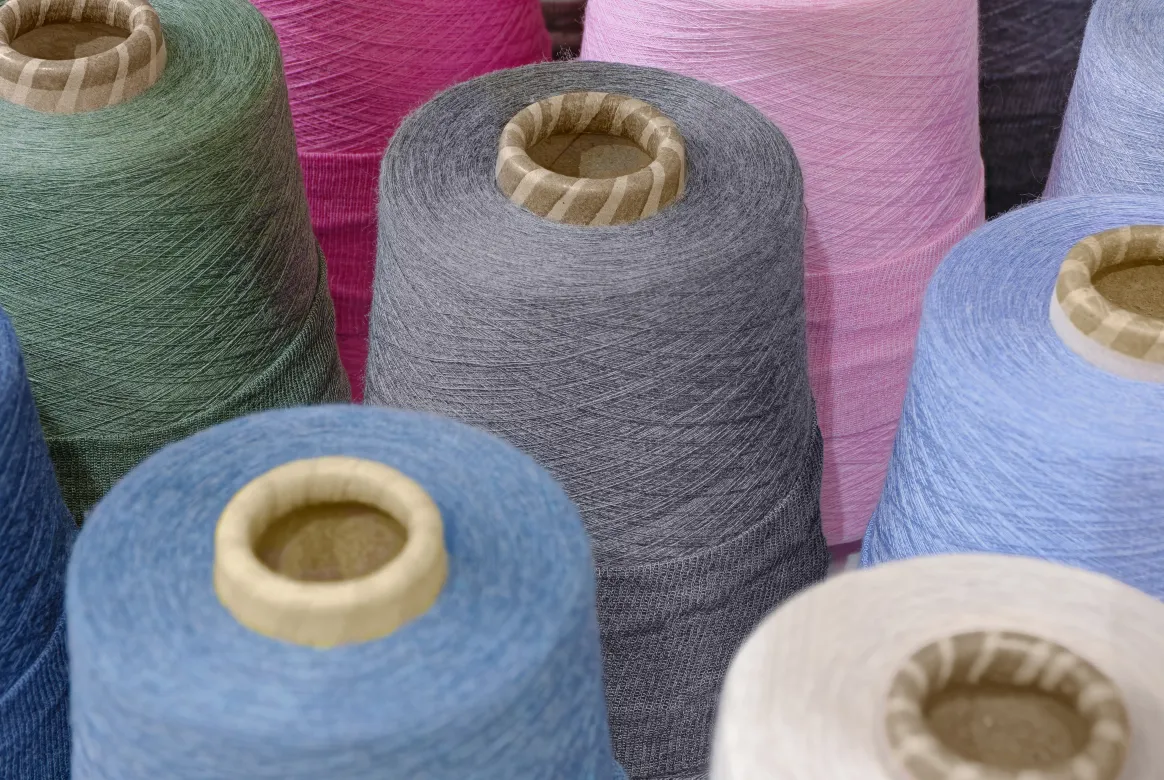
Yarn dyeing involves spinning the natural fiber first, then dyeing the finished cones of yarn. This method is mandatory for producing crisp, high-contrast intarsia, jacquard, or striped knitwear. Piece dyeing, conversely, involves knitting the entire garment in natural, unbleached yarn (greige) and submerging the finished sweater into a dye bath. Piece dyeing is highly efficient and offers rapid response times to seasonal Pantone trends, allowing brands to execute smaller MOQs per color.
Regardless of the method, elite dye houses utilize low-temperature acid dyes and precisely calibrated temperature curves to force uniform dye penetration without chemically "burning" the protein structure, which would result in a brittle, harsh hand-feel.
3. Spinning Architectures: Woolen vs. Worsted Yarn
Spinning is the mechanical process of drawing out the cashmere fibers and twisting them together to create continuous yarn. The chosen spinning architecture defines the physical characteristics of the finished knitwear.
Woolen Spinning (The Lofty Standard)
Woolen spinning is the traditional method used for 90% of classic cashmere sweaters. The carded fibers are crisscrossed and spun with a relatively low twist. This architecture deliberately traps microscopic pockets of dead air within the yarn, producing a highly voluminous, fluffy yarn with exceptional thermal insulation and a pronounced surface "halo."
Worsted Spinning (The Sleek Alternative)
Worsted spinning is an advanced, highly expensive process utilized for ultra-lightweight spring/summer collections, evening wraps, and men's fine suiting knitwear. The raw cashmere undergoes an additional "combing" step that extracts all short fibers and aligns the remaining long fibers perfectly parallel. The yarn is then twisted very tightly, expelling all trapped air. The resulting worsted yarn is extremely fine, incredibly dense, highly luminous, and virtually immune to pilling. It provides a sleek, fluid drape rather than a fluffy halo.
4. Flat Knitting Technology: Gauge (GG) and Tension Calibration
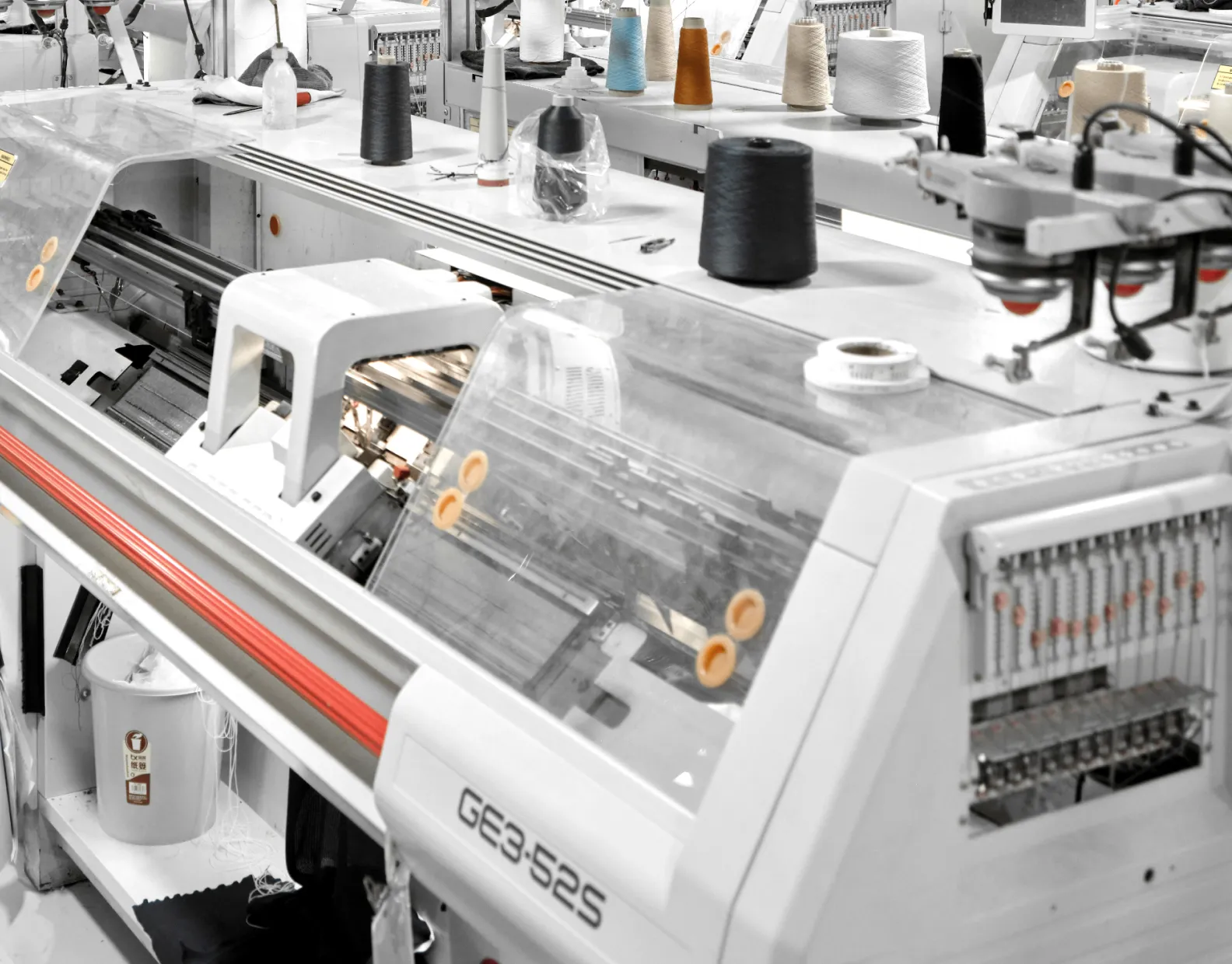
Cashmere garments are not woven on looms; they are knitted on computerized flat knitting machines using interlocking loops of yarn. Understanding machine gauge is critical for tech pack development.
Understanding Machine Gauge (GG)
Gauge (GG) indicates the number of knitting needles per inch on the machine bed. It dictates the physical density and weight of the sweater.
- 14GG to 16GG (Fine Gauge): Utilizes fine yarn (e.g., 2/48Nm to 2/60Nm) to produce lightweight, highly breathable trans-seasonal knitwear and sleek base layers.
- 7GG to 12GG (Mid-Gauge): The industry standard for classic autumn/winter pullovers and cardigans, typically utilizing 2/26Nm yarn. It offers the perfect balance of thermal loft and stitch definition.
- 3GG to 5GG (Chunky Gauge): Utilizes thick, multi-ply yarns to create heavy winter outerwear, deep cable knits, and oversized silhouettes.
Dynamic Tension Mapping
Knitting is essentially applied mathematics. Our technical programmers must calibrate the exact tension of the yarn feeders. If the tension is too tight, the resulting fabric will feel like a rigid, unyielding board. If the tension is programmed too loosely to save yarn weight, the sweater will lack structural integrity and "bag out" at the elbows and hem after a few wears. We execute dynamic tension mapping, programming the machine to knit tighter at structural anchor points (like the shoulders) and looser across the chest to allow for a fluid drape.
5. Garment Assembly: Fully-Fashioned Shaping and Hand-Linking
The assembly stage clearly separates mass-market commodities from authentic luxury knitwear.
Fully-Fashioned Knitting vs. Cut-and-Sew
Lower-tier factories utilize "cut-and-sew" methods, where they knit a massive, flat sheet of cashmere fabric, physically cut out the torso and sleeve shapes with shears, and sew them together using heavy overlock machines. This wastes immense amounts of expensive raw material and creates thick, abrasive internal seams.
Premium manufacturers execute "fully-fashioned" knitting. The computerized machine mathematically increases and decreases stitches to knit the exact shape of the front panel, back panel, and sleeves. There is zero fabric waste, and the edges (selvages) are perfectly clean and intact.
Hand-Linking (Cup Seaming)
Once the fully-fashioned panels are knitted, they must be assembled. Instead of pushing them through a sewing machine, highly skilled artisans utilize a specialized, circular linking dial. They manually mount the open, live stitches of the sleeve and the torso onto the dial, needle by needle, and join them with a single thread. This "point-to-point" hand-linking creates a completely flat, highly elastic, and nearly invisible seam that moves ergonomically with the wearer's body.
6. Wet Finishing (Milling): Engineering the Cashmere Bloom
When a cashmere sweater comes off the knitting machine, it feels rigid, flat, and unimpressive. The true magic of cashmere is unlocked entirely in the wet finishing stage, known in the industry as "milling."
The Mechanics of the Bloom
Milling is a highly sensitive washing process that utilizes precise water temperature, specific pH-neutral enzymatic softeners, and calculated mechanical friction. The agitation of the washing machine causes the tightly spun yarn to relax, allowing the tips of the cashmere fibers to burst forth and form a cloud-like layer on the surface of the fabric. This is the famous cashmere "bloom" or "halo."
The Risk of Over-Felting
Milling is the most dangerous stage of production. If a technician leaves a batch of sweaters in the milling machine for just two minutes too long, or if the water temperature spikes by five degrees, the friction will cause the microscopic cuticles of the cashmere fibers to lock together irreversibly. The sweaters will instantly shrink into rigid, matted felt, completely destroying the batch. Elite factories utilize specialized, low-capacity milling machines to ensure absolute control over this vital chemical and mechanical reaction.
7. Quality Assurance and Retail Logistics
Before leaving the factory, the finished knitwear undergoes intense scrutiny to ensure it meets rigorous B2B luxury standards.
Light-Box Auditing and Pilling Tests
Every single garment is pulled over an illuminated light-box mannequin. This intense backlighting immediately exposes any dropped stitches, uneven tension, or microscopic holes that are invisible to the naked eye. Simultaneously, batch samples are subjected to Martindale abrasion machines to scientifically verify their resistance to friction-induced pilling, ensuring the 36-38mm staple length was maintained throughout the spinning process.
Anti-Compression Packaging
Luxury knitwear cannot be vacuum-packed to save shipping volume. Crushing the garments destroys the delicate cashmere bloom and forces hard, permanent creases into the protein fibers. High-end cashmere must be loosely flat-packed with interleaving acid-free tissue paper, accompanied by silica desiccants to regulate humidity during maritime or air freight transit, guaranteeing the garments arrive retail-ready.
Partner with Zhejiang Dingchuang Cashmere
Founded in 2013, Zhejiang Dingchuang Cashmere operates a comprehensive, integrated manufacturing supply chain. We maintain strict in-house control over raw fiber collection and mechanical dehairing, securing only premium 36-38mm Inner Mongolian cashmere. We partner with specialized, long-term facilities for precision spinning, fully-fashioned knitting, and delicate wet finishing under our rigorous quality control protocols.
By managing the technical complexities from raw material sourcing to final light-box auditing, we eliminate the quality gaps and communication failures inherent in fragmented supply chains. We provide brand owners, independent designers, and wholesale distributors with tailored OEM/ODM knitwear solutions—delivering verifiable, premium cashmere garments that offer superior structural memory, profound softness, and exceptional retail value.
-

Dingchuang Textile Technical Team
Cashmere Sourcing & Knitwear Specialists, Dingchuang Cashmere
Authored by the technical specialists at Zhejiang Dingchuang Cashmere Co., Ltd. Founded in 2013 in Tongxiang, our team oversees integrated supply chain operations from raw goat cashmere collection and in-house mechanical dehairing to precision computerized knitting and specialty wet finishing, providing actionable manufacturing guidance for global apparel brands and designers.