
Cashmere Blend Engineering: Silk-Cashmere and Wool-Cashmere Ratios, Performance Trade-offs, and Labeling Rules for B2B Buyers
Pure cashmere commands the highest price point in the knitwear category, but it is not the correct engineering answer for every product. Lightweight spring silhouettes need drape and breathability that pure cashmere cannot deliver at fine gauges. High-rotation basics need abrasion resistance and shape recovery that pure cashmere delivers only at premium yarn costs. Blending solves these constraints deliberately, and the blend ratio is the single specification that determines what the finished garment actually does. This guide breaks down the two blend families that dominate luxury knitwear manufacturing, explains what each ratio changes mechanically and commercially, and sets out the labeling rules that govern how blends can legally be described in export markets. Buyers building cashmere blend programs should treat the ratio as an engineering decision, not a marketing one.
1. Why Blend Cashmere at All
Cashmere fiber is exceptionally fine (14 to 16 microns in premium grades) and exceptionally warm, but it has known structural limits: modest tensile strength, low elasticity compared with wool, and a tendency to pill when short fibers migrate to the fabric surface. Blending addresses these limits at the raw material level. The partner fiber is selected to contribute what cashmere lacks: silk contributes tensile strength, luster, and cooling breathability; wool contributes elasticity, resilience, and cost efficiency. A well-engineered blend does not dilute cashmere. It corrects a specific mechanical weakness while keeping the hand-feel signature intact.
Blending happens at the fiber stage, before carding and spinning. The two fibers are mixed in calibrated proportions and processed as a single composite, so the blend is distributed through the entire yarn body. This intimate blending is what separates engineered blend yarns from superficial fabric-level mixing, and it is why blend ratio documentation belongs in the tech pack alongside micron and staple length.
2. Silk-Cashmere: The Trans-Seasonal Luxury Blend
Silk is a continuous filament protein fiber with roughly three times the tensile strength of cashmere and a smooth triangular cross-section that refracts light into a natural sheen. Blended with cashmere, it produces a yarn that drapes fluidly, breathes in warm conditions, and resists the fiber migration that causes pilling. These properties make silk-cashmere knitwear the standard answer for spring and trans-seasonal luxury collections.
Standard Ratios and What They Deliver
- 70/30 cashmere-silk: The most widely used ratio in the segment. The cashmere majority preserves the soft handle and thermal character buyers expect; the 30 percent silk adds visible luster, fluid drape, measurably better pilling resistance, and enough breathability for warm-weather wear. This ratio is the default for lightweight 12GG and 14GG programs.
- 80/20 cashmere-silk: Prioritizes the cashmere hand-feel with a subtler sheen and moderate drape improvement. Appropriate for textured stitch work and trans-seasonal pieces where cashmere character should dominate, and a workable option when the target retail price sits between pure cashmere and 70/30 programs.
- 45/55 and silk-majority ratios: Read as silk knitwear with cashmere softness. Used for summer-weight scarves, wraps, and fine evening pieces where drape and sheen are the design intent.
Spinning and Dyeing Implications
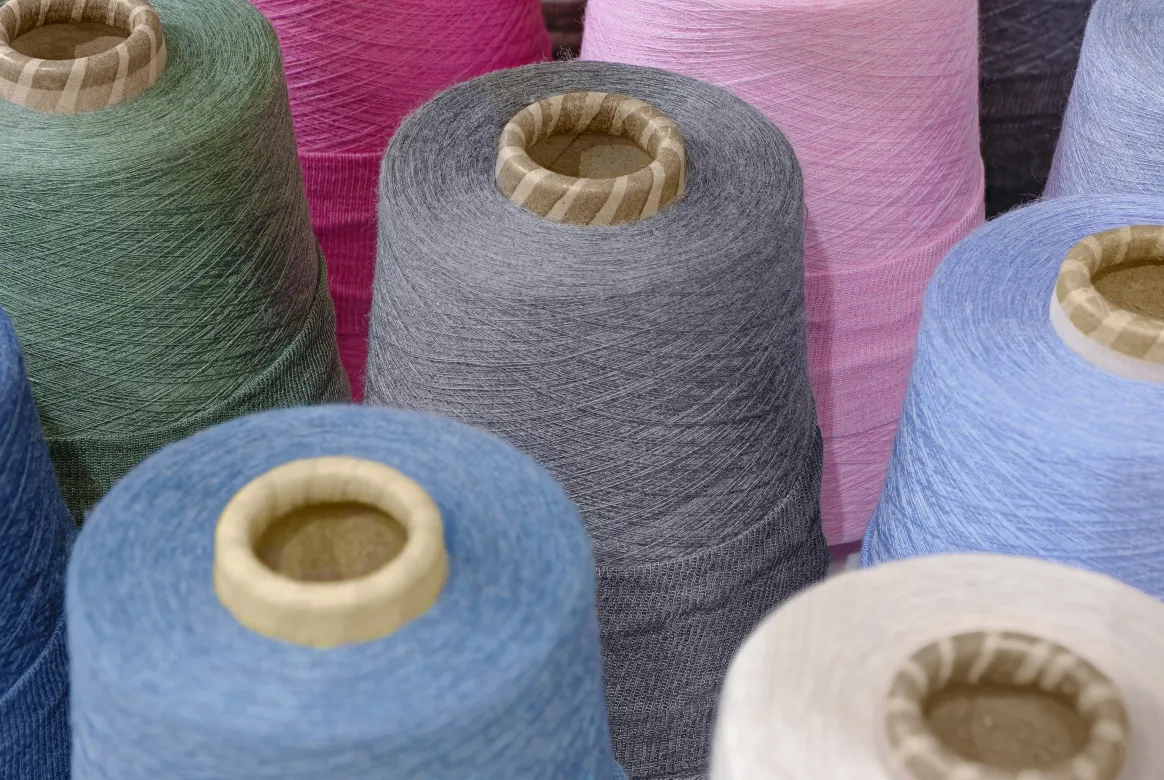
Because silk is stronger than cashmere, silk-cashmere blends can be spun to finer worsted counts, commonly 2/48Nm through 2/80Nm, supporting the fine-gauge fabrics these blends are designed for. Dyeing requires attention: cashmere and silk accept acid dyestuffs at different rates and affinities, so achieving a level, uniform shade on a blend demands a dedicated dye recipe. Buyers should require the dye house to validate color on the actual blend ratio, because a recipe perfected on pure cashmere will shade differently on a 70/30 blend. Our silk-cashmere yarn range is produced with lot-level color control for exactly this reason.
3. Wool-Cashmere: The Durability and Margin Blend
Wool and cashmere are chemically close relatives, which makes them the most compatible blending partners in the knitwear industry. Merino wool contributes crimp-driven elasticity, superior abrasion resistance, and shape recovery that cashmere lacks. The trade-off is a firmer hand-feel and reduced loft at higher wool shares. Cashmere-wool blend programs dominate the volume tier of the luxury market for a reason: they let brands put "cashmere" on the label at price points pure cashmere cannot reach.
Standard Ratios and What They Deliver
| Ratio (Wool/Cashmere) | Character | Best Application |
|---|---|---|
| 90/10 | Merino-led fabric with a perceptibly softer hand than pure wool; minimal cashmere signature | Volume basics, uniform knitwear, entry price points |
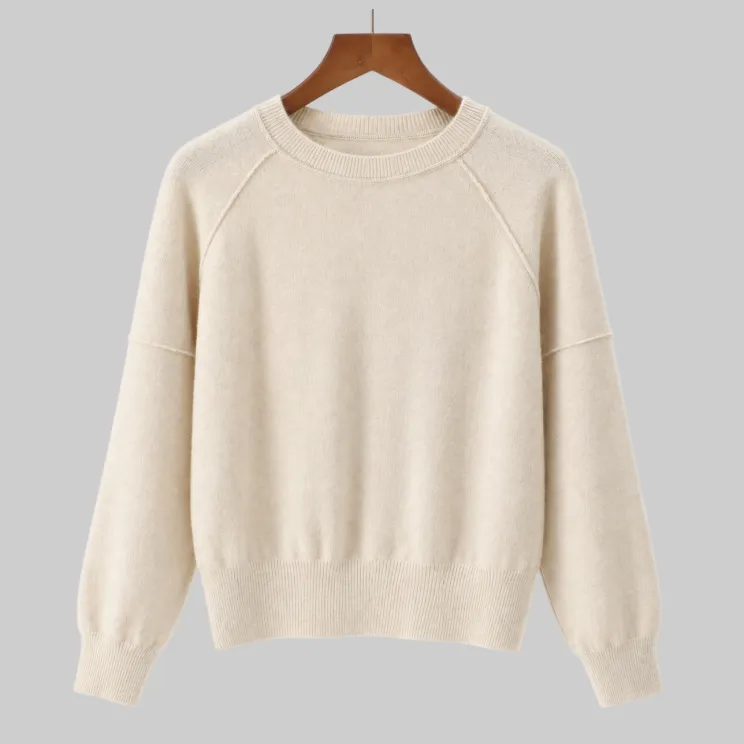
| 80/20 | Noticeable softness upgrade over pure merino; strong durability and shape retention | Mid-market premium sweaters, high-rotation retail programs |
| 70/30 | Balanced blend; cashmere hand-feel clearly present, wool resilience retained | Premium high-street and department store collections |
| 50/50 | Cashmere character dominates with wool-level durability | Outerwear-weight knitwear, accessories, travel retail |
One engineering note buyers should know: wool-cashmere blends pill differently depending on which fiber supplies the surface fuzz. In a well-spun blend with long-staple cashmere and fine merino, pilling performance often exceeds a poorly sourced 100 percent cashmere garment made from short-staple fiber. Fiber quality inside the blend matters more than the blend ratio on the label.
4. How to Specify a Blend in the Tech Pack
A blend specification that protects the buyer contains five elements:
- Blend ratio by weight, stated unambiguously (e.g., 70% cashmere / 30% silk), with the agreed tolerance. The industry-standard manufacturing tolerance is plus or minus 3 percent of total fiber weight.
- Fiber quality per component: micron and staple length for the cashmere share, grade for the silk (6A mulberry is the premium benchmark) or micron for the wool share (19.5-micron merino and finer for next-to-skin programs).
- Yarn architecture: count and ply (e.g., 2/48Nm, 2-ply), since blends behave differently across counts.
- Verification method: blend ratios are verified by quantitative fiber analysis (ISO 1833 series for chemical dissolution methods, or microscopy-based analysis). Require a test report per production lot for any program where the ratio carries the retail positioning.
- Labeling instruction aligned with the destination market, covered in the next section.
5. Labeling Rules for Cashmere Blends in the US and EU
Blend labeling is regulated, and the rules are stricter than most first-time importers expect.
United States: FTC Wool Products Labeling Act
Cashmere falls under the Wool Act, which defines it legally: dehaired undercoat fiber of the cashmere goat, average diameter not exceeding 19 microns, no more than 3 percent by weight of fibers over 30 microns, and a coefficient of variation not exceeding 24 percent. For blends, every fiber present at 5 percent or more must be named with its exact percentage by weight in descending order. Wool-family fibers must be named at any percentage. The label "cashmere blend" without percentages is illegal. The practical 3 percent tolerance applies to manufacturing variation, but it does not protect intentional mislabeling, and it never applies to a "100%" claim. If marketing references cashmere anywhere, the cashmere percentage must appear on the required label.
European Union: Regulation 1007/2011
The EU requires all fibers to be named with percentages in descending order of weight. Composition is calculated using agreed moisture regain allowances, notably 17 percent for carded animal fiber and 18.25 percent for combed fiber, which means the labeled percentage is a standardized figure rather than the as-weighed proportion. Multi-market programs should have composition certificates calculated on the correct basis per destination.
6. Cost and Positioning: Reading the Blend Decision Commercially
Raw cashmere costs multiples of fine merino or quality silk by weight, so every point of blend ratio moves the FOB price materially. But the correct frame is margin architecture, not cost cutting. A 70/30 silk-cashmere shell at 14GG can retail at pure-cashmere price points because the luster and drape read as luxury to the customer. An 80/20 wool-cashmere crewneck opens department-store programs that pure cashmere cannot price into. The blend decision should start from the target retail price and the garment's mechanical requirements, then work backward to the ratio that delivers both.
7. Developing a Blend Program with Dingchuang
Blend quality is decided where the fibers are selected. Zhejiang Dingchuang Cashmere combines direct Inner Mongolian fiber collection and in-house dehairing with documented blending, spinning coordination, and precision knitting at our Tongxiang base. We produce silk-cashmere, wool-cashmere, and specialty blend programs with lot-level ratio verification and market-correct labeling documentation for the US, EU, and UK. Share your target ratio, gauge, and retail positioning through our custom development channel, and our technical team will return yarn options with test data to match.
-

Dingchuang Textile Technical Team
Cashmere Sourcing & Knitwear Specialists, Dingchuang Cashmere
Authored by the technical specialists at Zhejiang Dingchuang Cashmere Co., Ltd. Founded in 2013 in Tongxiang, our team oversees integrated supply chain operations from raw goat cashmere collection and in-house mechanical dehairing to precision computerized knitting and specialty wet finishing, providing actionable manufacturing guidance for global apparel brands and designers.